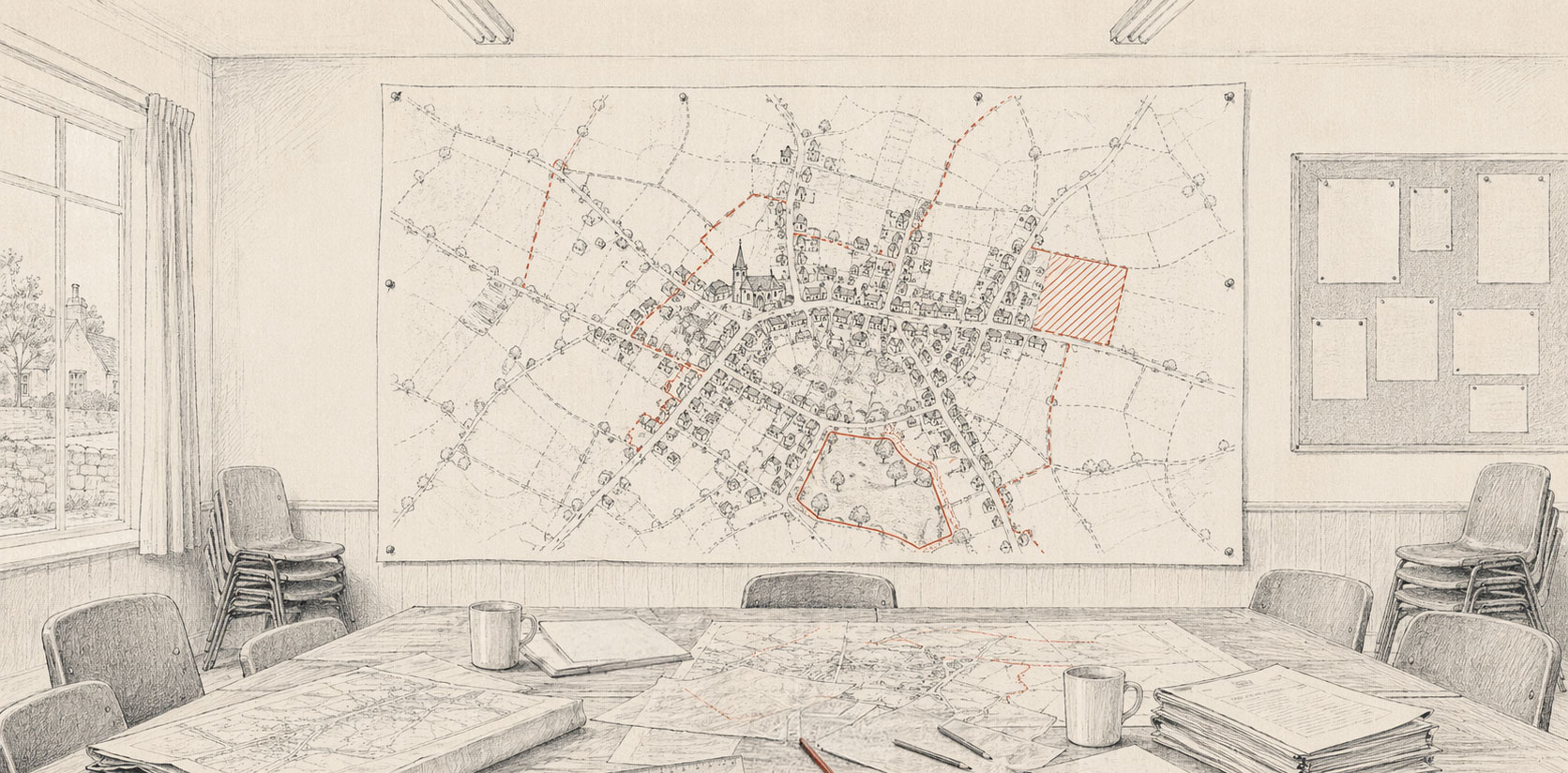
Every other explainer in this collection describes a force that acts on a community from outside: a housing target calculated in Whitehall, a five-year supply test applied by an inspector, a viability negotiation conducted between a developer and a council, a land deal struck between a farmer and a promoter. The neighbourhood plan is the one tool that works in the other direction. It is written by the community, voted on by the community, and once adopted it carries full legal weight in planning decisions. The question is how much that weight is worth when everything else in the system is pushing the other way.
What it is.
A neighbourhood plan is a legally binding land-use document written by a parish or town council, or in unparished urban areas by a neighbourhood forum of at least 21 residents. The legal basis is the Localism Act 2011. Once adopted, the plan becomes part of the statutory development plan under section 38(6) of the Planning and Compulsory Purchase Act 2004, which means planning decisions must be made in accordance with it unless material considerations indicate otherwise. It carries the same legal weight as the district's Local Plan. Where the two conflict, the more recently adopted document prevails.
Over 1,800 neighbourhood plans are now in place across England. That sounds like a movement, but it represents only about 15 to 16% of the roughly 10,000 parish councils. Three quarters of plans have been produced in the south of England. Two thirds are rural. Almost 40% originate in the least deprived local authority areas. Neighbourhood planning has been overwhelmingly a southern, market-town and commuter-village activity. Deprived urban areas and much of the North remain near-blank on the map.
To reach adoption, a plan must pass examination by an independent examiner (not a planning inspector) who tests it against the basic conditions: regard to national policy, contribution to sustainable development, general conformity with the strategic policies of the Local Plan, and compliance with environmental regulations. It then goes to a local referendum. A simple majority of those voting is enough. There is no minimum turnout. Average turnout runs between 30% and 45%, with yes votes averaging 87%. Failures are rare enough to be news.
What it can do.
The scope is wider than most people assume. A neighbourhood plan can allocate specific sites for housing. It can set design codes that future development must follow: materials, building heights, street patterns, density, character. It can designate Local Green Spaces, which receive protection equivalent to Green Belt under paragraphs 105 to 107 of the NPPF. It can influence housing mix and tenure, protect community facilities like village shops and pubs, set policies on heritage and views, and require features like tree-lined streets.
To take a practical example: a neighbourhood plan in a Cotswold village could require that all new homes use local stone, have pitched roofs no higher than two storeys, and front onto the street rather than hiding behind parking courts. It could require boundary walls rather than close-boarded fencing and specify that cul-de-sacs are not acceptable. Those are design details the district plan does not cover at parish level, and they carry full legal weight in planning decisions. But if the district's Local Plan allocates 200 homes to a site on the edge of that village, the neighbourhood plan cannot say it only wants 100. It cannot set a density so low that the allocation cannot be delivered. And if the NPPF says brownfield development should be approved unless substantial harm would be caused, the neighbourhood plan cannot add a local policy that contradicts that. The neighbourhood plan can go further than the policies above it. It cannot go against them.
The most tangible incentive is financial. A parish with a made neighbourhood plan receives 25% of Community Infrastructure Levy receipts from development in its area, with no cap. Without a plan the share is 15%, capped at £100 per existing council-tax dwelling per year. In districts with active development pipelines, that difference is significant. The neighbourhood CIL portion can be spent far more broadly than the strategic portion: not only on infrastructure but on anything that addresses the demands development places on an area, including affordable housing and even reviewing the plan itself.
Thame in Oxfordshire remains the strongest example. Its 2013 plan allocated around 775 homes across five edge-of-town sites, won an RTPI Planning Excellence Award, and was delivered. CIL and Section 106 contributions funded refurbished sports pitches, floodlit rugby facilities, and reserve capital for a new youth and community hub. Thame's successor plan passed referendum in February 2025, extending the horizon to 2041. The lesson is consistent across every study of neighbourhood planning: plans that positively allocate growth, rather than merely resist it, are the ones that carry the most weight with inspectors, courts, and developers.
What it cannot do.
A neighbourhood plan cannot set a housing target lower than the Local Plan requires. It must be in general conformity with the strategic policies of the development plan. It cannot block sites the Local Plan has already allocated. It cannot override the National Planning Policy Framework. It cannot deal with minerals, waste, or nationally significant infrastructure. From March 2026, the general conformity test is being replaced with a narrower condition: the plan must not result in less housing being provided than if it were not made. The floor against under-planning survives, but the wider conformity requirement loosens.
The examination process is lighter than for a Local Plan. The examiner tests legal compliance and the basic conditions only, not soundness. The process runs largely on written representations. Public hearings are rare. But the examiner can require modifications, and the plan must accommodate whatever housing requirement the district has set for the neighbourhood area. A parish that wants to use a neighbourhood plan to prevent development will find the examiner blocks it at the basic conditions stage.
Get the dispatch.
Long-form, data-first, independent. Housing, planning and infrastructure reporting delivered free to your inbox.
What happens when the plan gets old, or the system comes under pressure.
This is the section that matters most for any parish councillor whose plan was made several years ago.
The NPPF gives neighbourhood plans a specific protection under paragraph 14. When the tilted balance is engaged because the council cannot demonstrate a five-year housing supply, paragraph 14 says the adverse impact of allowing development that conflicts with a neighbourhood plan is likely to significantly and demonstrably outweigh the benefits. In plain language: the plan wins, even when the council is failing. This is the strongest protection neighbourhood plans have ever had. But it comes with two conditions. The plan must have been made within the last five years. And it must contain policies and allocations to meet its identified housing requirement.
Both conditions must be met. A plan that is purely protectionist, with no housing allocations, gets no paragraph 14 protection even if it was made yesterday. And a plan that allocated housing perfectly but was made six years ago also gets no paragraph 14 protection, regardless of whether its plan period runs to 2030 or 2035. The five-year clock runs from the date the plan was made, not from the end of the plan period. This catches many parish councils by surprise. A plan made in 2019 with a plan period to 2031 lost its paragraph 14 shield in 2024. The plan period is irrelevant to the calculation.
What happens once the protection expires and the council lacks five-year supply? The tilted balance under paragraph 11(d) engages. The plan's housing supply policies are deemed out of date. But "out of date" does not mean "ignore." The Supreme Court was clear on this in Suffolk Coastal v Hopkins Homes (2017): the weight given to any out-of-date policy is a matter of planning judgment for the decision-maker. An inspector will consider how severe the housing shortfall is (a district at 4.2 years of supply is very different from one at 1.8 years), whether the shortfall is likely to be reduced soon, and whether the plan's overall spatial strategy remains sound. A neighbourhood plan whose sites have been delivered and whose strategy still reflects the shape of the settlement carries more weight than one that has been overtaken by events.
The non-housing policies survive regardless. Design codes, Local Green Space designations, heritage and character policies, community facility protections: these are not policies for the supply of housing. They are not deemed out of date by the tilted balance. They retain full development plan weight whether the plan is two years old or twelve. For many parishes, these are the most durable and valuable parts of the plan.
The remedy for an ageing plan is to review it. A review restarts the five-year paragraph 14 clock. The process is simpler than the original plan if the changes are minor, using a modified examination route. But it still requires volunteer time, professional support, examination, and referendum. Many parishes that made plans between 2015 and 2019 are now discovering they need to review and are struggling to find the capacity, particularly since Locality grant funding was cut in June 2025.
One further distinction matters. Paragraph 14 protects against speculative planning applications from developers. It does not protect against allocations in the council's own Local Plan review. The Kemble and Ewen Neighbourhood Plan passed its referendum with 89% support in May 2021. For three years it worked as intended: the district had a healthy housing land supply and the plan's policies had full weight. Then the December 2024 NPPF doubled Cotswold's annual housing target. The district fell below five-year supply. The council's own draft Local Plan now proposes a strategic extension of around 590 homes south-west of Kemble, which would more than double the village. Kemble's neighbourhood plan cannot stop this. No neighbourhood plan can override the Local Plan it was written to conform with when that Local Plan is replaced by a new one with different strategic allocations.
Is it worth it.
The honest answer depends on what the community wants and what the district's planning position looks like.
The costs are real. Typical expenditure runs from £20,000 for a simple parish plan to £100,000 or more for one that allocates sites and prepares a design code. The timeline is three to five years of volunteer work. Research by the University of Reading found that 92% of groups reported the process more burdensome than expected. And since June 2025, the Locality grants that underwrote hundreds of plans since 2013, providing free technical support, design-code packages, and grants of £10,000 to £18,000, have been cut. Groups starting now must self-fund from the parish precept.
A neighbourhood plan is likely to repay the effort when the district has an up-to-date Local Plan and can demonstrate five-year supply, because in that scenario every policy in the plan carries full weight. It is worth it when the primary goals are design, character, Local Green Space, and community facilities rather than controlling housing numbers, because those policies survive even when the tilted balance overrides the housing supply policies. It is worth it where the district charges CIL and has an active development pipeline, because the 25% uncapped share produces real money for the parish. And it is worth it when the community is willing to positively allocate growth and has the volunteer capacity to sustain a multi-year project.
It is unlikely to repay the effort when the primary motivation is to stop development, because the basic conditions will block that at examination. It is unlikely to be worth it when the district already lacks five-year supply and has poor delivery, because the tilted balance will routinely override the housing policies. And it is hard to justify when there is no CIL charging schedule in the district and no prospect of one, because the financial incentive disappears.
A narrower tool than promised.
The neighbourhood plan is not the community empowerment revolution the Localism Act promised. It is a narrower, sharper instrument: real power over design, green space, heritage, and a bigger share of developer money, in exchange for years of volunteer labour and the acceptance that strategic housing numbers are set above the parish. The December 2024 NPPF simultaneously strengthened the legal shield (paragraph 14 now runs five years without the delivery preconditions that used to disapply it) and weakened the political context (higher targets, more failing councils, central funding scrapped).
If you want to shape what gets built, how it looks, and where the money goes, a neighbourhood plan is the only tool that gives you a legal seat at the table. If you want to prevent what gets built, the planning system has already decided that question.— The Editor · Ground Level, June 2026
For a parish considering starting one now, the test is simple. If you want to shape what gets built, how it looks, and where the money goes, a neighbourhood plan is the only tool that gives you a legal seat at the table. If you want to prevent what gets built, the planning system has already decided that question, and a neighbourhood plan will not change the answer.