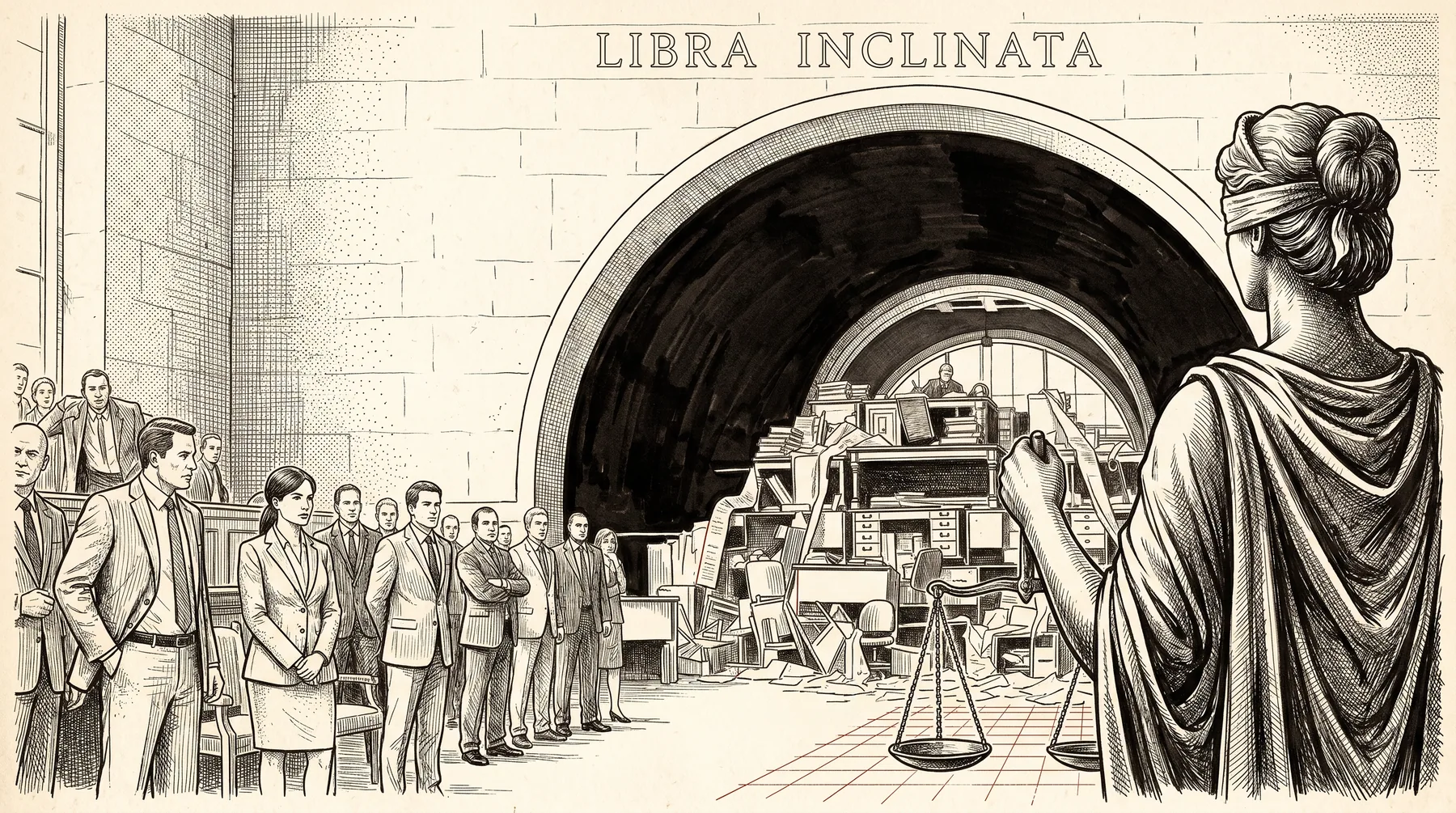
Our piece The Housing Algorithm described a machine. A government formula sets each council a housing target based on local house prices, not on any measure of need. The target is set so high the council cannot physically meet it. Its five-year housing land supply collapses as a result. A clause in national planning policy, the "tilted balance," then flips the presumption in favour of granting permission. We set out how that single mechanism overrides the plan-led system, the local plans, neighbourhood plans and design standards meant to govern where and how England builds, and how the countryside is reshaped once that framework gives way.
Machinery is hard to see while it runs. So here we follow one case from a unanimous local refusal to a permission granted on appeal: one field, at the western edge of one Cotswold town. It is an ordinary case, and that is why it is worth your time.
The decision.
On 15 June 2026, a Planning Inspector named Rachel Hall allowed an appeal for up to 54 homes on a field north of The Wern, in Lechlade. The permission is outline, with everything reserved except the access. The houses are not built yet. But the principle is now settled, and the principle was the whole fight.
Read the decision letter and a strange thing becomes clear. The Inspector did not disagree with the people who opposed the scheme. She found that the development would harm the rural character of the site. She found that it would harm the setting of a Grade II listed building. She found that it conflicted with the Cotswold District Local Plan and the Lechlade Neighbourhood Plan, taken as a whole. And then she granted it.
This is not a contradiction. It is the system working as designed. The Wern is the machine described above, given an address.
The objections were not rejected. They were outweighed by a number the council had no power to change.— The Editor · Ground Level, June 2026
The field.
The site is an agricultural field, set back from the A417 behind another field, bound by mature hedgerow, with open countryside to the north and west. The Inspector accepted it "appears as part of the open countryside that surrounds the town." It sits beside Butler's Court, a 17th-century former farmhouse, listed Grade II, whose setting is bound up with the farmland it once worked, including this field, which evidence before the Inspector showed was historically in the same ownership.
None of this was a surprise to Cotswold District Council. Its own evidence base had already reached a verdict. The council's 2021 Strategic Housing and Economic Land Availability Assessment, the document councils use to decide which sites are fit for development, found land including this site unsuitable, citing harm to a Scheduled Ancient Monument, to a listed building, and to the rural approach to Lechlade.
So the council refused materially similar proposals for this land more than once. In July 2025, when the latest version came back as a formal application, its planning committee refused it unanimously.
Everyone with a say said no. The council's officers said no. The council's evidence said no. The councillors said no. The Town Council said no.
The collapse.
The council went to the hearing with six reasons for refusal. By the time the Inspector ruled, half of them had gone.
Reasons four and five concerned ecology: that the developer, Hallam Land, had supplied insufficient information on biodiversity and on net gain. Hallam Land responded with updated surveys for bats, birds, reptiles, newts and more, and the council confirmed it would no longer defend either point. Reason six concerned the lack of a legal mechanism to secure affordable housing and financial contributions. That fell away the moment the Section 106 agreement was signed, on 27 May 2026, after the hearing.
Three reasons, gone. The council had been right to raise them. A well-resourced applicant simply cleared them off the table with fresh paperwork and a signed agreement.
That left two genuine contests: harm to the character of the area, and harm to the historic environment. On both, the council was vindicated. The Inspector found real landscape harm, and gave it "moderate weight." She found real harm to the setting of Butler's Court, "less than substantial," but, in her words, of "considerable importance and weight."
The council won the argument. It lost the appeal. To understand why, you have to look at a single number that made the argument almost beside the point.
The arithmetic.
Both sides agreed it. Cotswold District Council can demonstrate 1.8 years of housing land supply against the five years national policy requires: a shortfall of around 3,493 homes.
That number is the engine of the whole decision. Because the council cannot show a five-year supply, paragraph 11 of the National Planning Policy Framework engages: the "tilted balance." From that point, the planning system stops asking whether the development is a good idea and starts asking whether it is bad enough to refuse anyway. The bar is deliberately high.
Watch what it does to the council's own policies. Policy DS4, the policy that exists precisely to stop open-market housing being built in open countryside outside settlements, was reduced to "very limited weight." The council didn't even contest this. It conceded it could give DS4, at most, very limited weight itself, because a policy strategy that is failing to deliver housing cannot be given much force against housing.
Then the heritage harm was tested. Designated heritage is meant to be the one protection that survives the tilted balance: harm to a listed building can be a strong enough reason to refuse on its own, even when the council cannot show five years of supply. The council argued exactly that, and pointed to other appeals where it had held. The Inspector set them aside. Because the harm here was only "less than substantial," she found, the public benefits outweighed it and the protection did not apply. That distinction reaches well beyond Lechlade. The great majority of heritage harm is classed "less than substantial." A safety net that only catches substantial harm catches very little.
That left the final test: permission must be granted unless the adverse impacts "significantly and demonstrably" outweigh the benefits. The Inspector weighed moderate landscape harm and limited heritage harm against the housing, and concluded they did not. The appeal was allowed.
Note what the housing shortfall did and did not require. It did not require the Inspector to find the objectors wrong. She didn't. It only required her to find their concerns insufficiently grave to clear a bar set deliberately out of reach. The harm was real. It was simply priced in.
The asymmetry.
Now look at the room, because it tells you who this system is built for.
Representing Hallam Land: a King's Counsel, Martin Carter of Kings Chambers, instructed by the planning consultancy David Lock Associates, supported by specialist firms in affordable housing, ecology, landscape, heritage and viability. Six professional outfits and a silk.
Representing Cotswold District Council: four of its own officers, a principal planning officer, a conservation officer, a strategic policy manager and a landscape officer. Representing the town: its mayor, Councillor Steve Trotter, and a neighbouring councillor from Fairford.
This is the contest the tilted balance actually produces. Not a town meeting about whether a field should become an estate. A technical, adversarial hearing in which a public authority's in-house staff defend a refusal against a private team assembled and paid to dismantle it, clause by clause, survey by survey. The residents who turned up to object about flooding, with photographs of the November 2024 storms, were answered by a commissioned drainage model that attributed the flooding to poor maintenance of the existing network rather than the proposal. Local experience against retained expertise. The bar was never going to be cleared from that side of the room.
The capacity isn't there.
Read the conditions and the legal agreement and a second story surfaces, about the things that are supposed to be in place before anyone can live somewhere.
The catchment secondary school is forecast to be full. So the agreement secures a contribution to bus children from these homes to schools more than three miles away. Lechlade Medical Centre needs an extra £63,829 of clinical capacity to absorb the new patients. And no home may be occupied until Thames Water confirms there is foul drainage and water-supply capacity to serve it, or a phasing plan is agreed, because at present that capacity is not demonstrated.
These were not objections the scheme had to overcome. They are the terms on which it proceeds. The homes are approved first; the school places, the surgery capacity and the water network are left to catch up. The tilted balance does not pause to ask whether the town can absorb what it is being given. It asks only whether the absence of that capacity is grave enough to outweigh the housing. It never is.
A template, not an exception.
The most important thing about the Wern is that there is nothing unusual about it. It stands out only for having run the full course, from a unanimous refusal to a permission granted on appeal, while most schemes like it are still somewhere in the pipeline.
Strip away the twenty-one pages and one fact decided this appeal: the council cannot show five years of housing land supply. The rest was process.
Be blunt about what that does. The Inspector assessed the merits and found against the scheme on them. Landscape harm. Harm to a listed building. Conflict with the Local Plan and the Neighbourhood Plan. In a district with an up-to-date plan, that combination refuses applications and the refusals hold. Here it refused nothing, because the supply failure inverts the test. The council no longer has to show the scheme is acceptable. It has to show the harm is grave enough to defeat a presumption that the scheme should be approved. Acknowledged harm to the countryside and a listed building did not clear that bar. Almost nothing does.
This is not a Lechlade problem. Every district council in Gloucestershire is below the five-year threshold, with published figures running from Cotswold's 1.8 years up to Tewkesbury's 3.65. Not one can demonstrate a lawful supply. Nationally, 189 councils are in the same position. Each of those shortfalls is a tilted balance waiting for an applicant, and the Wern is what it looks like when one of them runs to completion.
The same logic has already reached the next field. The Inspector pointed to a second Lechlade scheme, 150 homes on the north-eastern edge, to show the shortfall is unfillable: build those 150 and the district is still thousands of homes short. Read through the mechanism, the implication is colder. The supply gap that emptied the Wern's objections of weight has not closed, so the 150-home scheme starts from the same presumption in its favour, before a single objection is weighed. Whether it is approved will turn on whether its own harms are judged severe enough to override that presumption. On the evidence of the Wern, that is a very high bar.
And the gap will not close on its own. If Cotswold cannot deliver 1,036 homes a year, and it cannot, supply stays below five years indefinitely. The Inspector said as much, finding no indication the shortfall would be resolved in the near future. The council's own committee papers warn that local government reorganisation, now under way across Gloucestershire, could force the Local Plan to restart, leaving the district without an up-to-date plan for five to seven years. The shortfall that approved one field is wide enough to carry the next, and the one after that, until a plan catches up that reorganisation could push half a decade away.
The council has not pretended otherwise. In a statement on 18 June, three days after the decision, Cotswold District Council said it was disappointed the Inspectorate had overturned its refusal, and named the cause without flinching. Government housing targets, it said, together with the requirement to keep enough land in supply to meet them, mean that "the balance is increasingly tilted in favour of development." Its options now, it admitted, are to spend public money on appeals "that are increasingly difficult to win," or to step back "where the odds are stacked against local decision-making." That is the authority that lost describing the same machine, in its own words.
What it means.
It is tempting to say the countryside is being lost to no decision at all, that a formula did it and there is no one to answer for it. That is the comfortable version, and it is wrong.
Locally, everyone with a say said no. Lechlade's councillors voted against the scheme, the officers advised against it, the council's own evidence had ruled the land unsuitable years earlier, and the Inspector who allowed it still found it would harm the landscape and the setting of a listed building. No one in Lechlade decided this field should be built on. But a decision was made, earlier and higher up, by the people who wrote the rules. The revised National Planning Policy Framework of December 2024 made the inflated target mandatory, removing the discretion councils had held a year before, and in the same stroke stripped out the exceptional circumstances clause that had let constrained areas like the Cotswolds, where eighty per cent of the land is nationally protected, argue for a lower figure. The government removed that route deliberately, after consultation, having been told exactly what it would mean. What followed was not an accident three steps removed from anyone. It was the formula working as intended. The target the council cannot meet collapsed its land supply to 1.8 years, which stripped its own protective policies of their weight, which set the bar for refusal too high to clear. The decision was real. It was simply moved to where no councillor sits and no resident can vote.
This is how the rural edge of a market town changes now, not by accident but by design, with the harm acknowledged and permitted in the same breath. The decisions are no longer made field by field, in public, by people who can be voted out. They are made in advance, by a target and a presumption that no councillor chose and no resident can challenge.
There is a colder mechanism buried in the decision. To set aside the harm to Lechlade's Conservation Area, the Inspector reasoned that if the neighbouring allocated site is also built out, that development would screen the appeal scheme and ease the transition from countryside to town. Follow the logic. The prospect of more development is used to justify this development. Each approval becomes the backdrop that makes the next one acceptable. This is how open country goes, as a ratchet, every field that turns lowering the bar for the field behind it.
A field doesn't become an estate because someone decided it should. It becomes one because a formula left no lawful way to refuse.— The Editor · Ground Level, June 2026
The decision letter for the Wern runs to twenty-one pages of careful, reasoned planning judgement. Read it and you will not find a villain in the room. Everyone in that hearing was doing their job within the rules. But the rules did not write themselves, and the land supply did not fall below five years by chance. The unreachable target, the tilted balance that punishes the shortfall and the protections loosened beforehand were each a deliberate choice, made nationally, with the consequences for places like Lechlade entirely foreseeable. The system did not fail at Lechlade. It did what it was designed to do. That is the harder thing to sit with. The people in that room cared about the countryside in one way or another. It is being reshaped anyway, by a mechanism built so that caring about it is no longer enough.
The next application is already in. So is the one after that.